

Daily Prayer
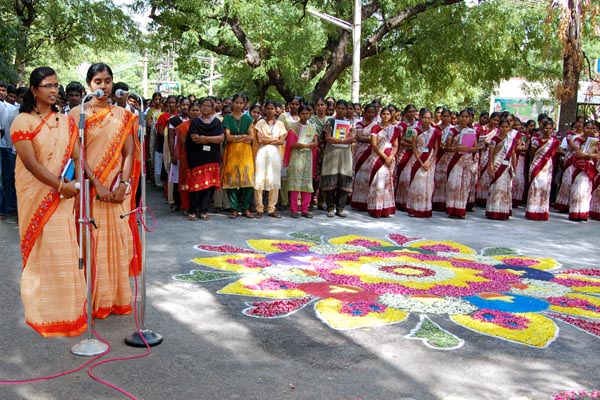
All working days of Institute (except during exam days) begin with the congregation of students and staff members at Bell Maidan, to join morning prayer at 9.15 a.m. Such congregation has a refreshing and renewing effect on the minds and hearts of those gathered under the canopy of the vast peepal tree. The Prayer begins with a spiritual song meant for each day of the week, followed by a reading of an evocative ‘thought for the day’. Significantly, the prayer songs and recital of inspirational quotes from eminent thinkers are performed by students of different Departments that are designated, on a rolling basis, to organize the Daily Prayer for one week every semester. This develops artistic, public speaking and organizational skills in the students. This immensely unique activity happens in a highly decentralized manner with the organizing Departments enjoying absolute autonomy in deciding the content and identifying the student performers.
The occasion of the prayer is also used for making important announcements, felicitating academic/sports achievers and introducing renowned guests/visitors who have visited the Institute and chosen to participate in the morning prayer. The Daily Prayer, by bringing students and staff together, personalizes the relationship between students and staff as well as among students of different programmes, even, as it reaffirms a sense of belonging to GRI in them.
Inter-religious Prayer
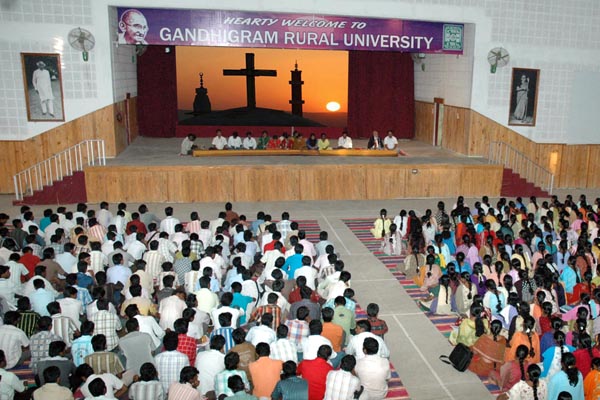
Organized and managed entirely by the students of the Institute, this solemn activity involves singing devotional songs of all major faiths, alternated by recital of selected verses from Bhagavat Gita, Holy Quran and Holy Bible. Occasionally, religious leaders professing any one of the major faiths are invited to deliver talks and lectures in an effort to promote inter-faith understanding. What had begun as a prayer programme, has, over a period of time, evolved into a GRI community get-together, to share and brief the GRI activities to one another. Hence, latter half of the programme is devoted to informing the significant happenings and notable achievements of the different Departments of the Institute in the form of a news compilation called ‘GRI Valam’ (GRI Roundup).
Inter-Religious Prayer and Inter-Faith Dialogue are the cherished ideas of Gandhiji to promote communal harmony and peaceful co-existence. Deeply inspired by this ideal, Gandhigram Rural Institute encourages the assembly of all its staff and students on all working Fridays at 4.00 pm, in the hallowed Multipurpose Auditorium of GRI for Inter-Religious Prayer.
Daily Flag Hoisting
None has extolled the power of the Flag to unify diverse population of India, more powerfully than Mahatma Gandhi. Similarly, none had spent more time and written more in designing the Flag, than Gandhiji during heydays of Freedom Movement of India. Our National Flag today is deeply influenced by the inputs that Gandhiji had meticulously provided, during the pre-independent Days.
Hence, it is small wonder that Gandhigram Rural Institute, having been founded on the principles of Gandhiji, pays rich tribute to our National Flag by ceremonially and solemnly hoisting it at 8.00 AM every day at the historic Bell Maidan, thereby aspiring to instill patriotic sprit in all the stakeholders of the Institute, and as a mark of respect for all the freedom fighters, who fought for us to enjoy the right to hoist and salute, our own National Flag.
Indeed, the morning ceremonial activities of the Institute starts with solemn hoisting of the National Flag of our great Nation, in strict accordance with the procedures spelled out by the Government of India, followed by Morning Prayer at 9.20 AM, before commencement of regular academic activities at 9.30 AM.
Shramdhan
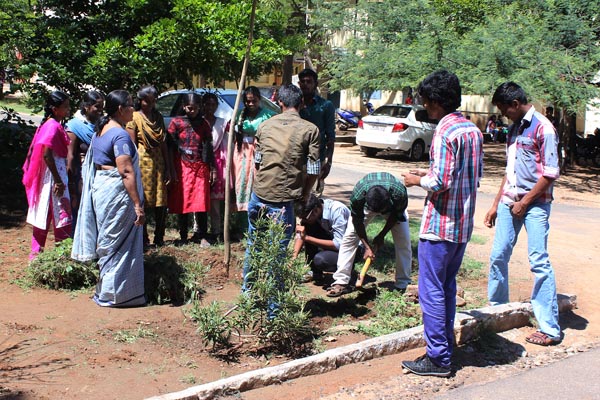
Every week, an hour’s time of class work is set aside for Shramdhan activities in the time-table of all Diploma, UG, and PG programmes. During this hour, all students, scholars and staff enthusiastically and collectively engage themselves in cleaning of class rooms, offices, laboratories as well as the surrounding areas of the Departments. Besides undertaking cleaning work, tree planting, gardening and landscaping works are also taken up by them on days of national and international importance such as World Environment Day, World Earth Day, and the like. Shramdhan activities invariably generate deep respect for physical work in the minds of students and staff, in a society that tends to unjustly place higher value in mental work. In recent years the central Government's 'Swachh Bharath Mission' has given a new flip to the Shramdhan activities in GRI.
The Gandhian concept of Nail Talim (Basic education) is built on the foundational idea that knowledge and work (understood as physical labour) are organically linked and derive their essence from one another. Shramdhan (Serving by labouring) is a Gandhian way of celebrating physical labour. Right from its inception Gandhigram Rural Institute has accorded Shramdhan a pride of place in its corporate life as well as in its curriculum.
Gurukula
Gurukula (Mentoring) system is as old as Gandhigram Rural Institute and is part of GRI ever since its inception in 1956. It is an age old system under the traditional educational world and it was operated in the original rural institute at Gandhigram. Further, the system has been continuing even after the declaration of the university status in the year 1976. All the Teachers and students, known as Gurus and Shishyas were soaked under the Gurukula System. Every Guru is made responsible for building and moulding the character of individual student with a view to uproot one of the social sins, “education without character” as identified by Mahatma Gandhi. However, the total personality of the students was shaped by Gurus under the educational system evolved by the founders of Gandhigram Dr.T.S.Soundaram and Dr.G.Ramachandran - the founder Vice-chancellor of Gandhigram Rural Institute. It is envisaged that all-round development of the student in the Institute can take place through the Gurukula system. Such a system will no doubt shape the personality of the future generations. The Gandhigram Rural Institute – Deemed University has been trying to follow the old system with some modifications based on its experiments and experiences with the above system.
Each year, the students admitted under the graduate, Post-Graduate and M.Phil programmes are allotted Gurus. The number of shisyas allotted to each teacher is arrived at by dividing the total number of students in a class by the number of Gurus (Faculty Members) available in the concerned Department. The allotment is done fairly thorough a lot system to avoid arbitrary selections of shisyas. They meet the Gurus at the designated time (decided by each department and incorporated into the weekly timetable) each week to discuss their progress in studies, difficulties faced and other personal, interpersonal and career issues. These gurus also serve as their course advisor, career counsellor and as well-wisher.
Objectives
- To build a dynamic team for total development of each student (Shisya) to face academic and personal challenges
- To cover the educational and the supportive fraternity within the campus
- To form a powerful partnership for comprehensive character education and moral ideal of students.
- To maintain body discipline, mind discipline as well as work discipline.
Vision and Mission
- Education of the whole person - students
- Realizing full potential and the individual capacity
- Inculcating moral reasoning through a moral code thus shaping moral identity
- Drawing out the best from body, mind and soul.
Strategy
- As GRI is wedded to extension work, every group under the Gurukula system undertake and experiment with the village work.
- Small is beautiful as it is said. Every Guru in GRI has a small group of Shisyas, 5-10 in the given academic year. No teacher should be left without students and village based youth group.
- Gurukula system is linked with Extension work. Every Guru can organize the extension programme in tune with the objectives of the institute.
- A periodical review meetings of Gurus are organized.
Constitution
- As GRI is wedded to extension work, every group under the Gurukula system undertake and experiment with the village work.
- Gurukula is a constitutional unit of the university system and all the Gurus are vested with some powers and responsibilities, in particular, each and every activity of the individual student should be revolved around a Guru - like a honey bee system.
- All academic affairs, curricular and co-curricular activities of every student have the sanction of the Guru for the growth of the system.
- As far as possible, Gurukula has a mixed system of both social science and physical sciences with a view to have cross fertilization of ideas and inter - intra faculty and departmental relationship and to remove fear psychosis of other department students as practiced in the original rural institute.
- Every Guru has the freedom to design any programmes for a group his / her own Shishyas - students and to execute it independently including undertaking a picnic and other programmes of academic nature and curricular as well as co-curricular activities.
- All the representations including official correspondence, application for examination like an appeal form and grievance petition etc. of the students should be routed through the Guru.
- All the recommendations of the Guru must be considered in the right spirit depending upon the nature of the case. If at all there is any negative recommendation, the application of the student not considered for further action.
- The Guru is consulted before constituting the enquiry committee pertaining to the individual student.
- While considering the application of each student under “earn while you learn scheme, scholarship, fellowship and other benefits, the recommendations of the Guru is treated as vital without which no sanction is accorded”.
- All the Gurus irrespective of the position/rank have a deep faith in the Gandhian Ideology and he / she contributes his / her might for raising the Gandhian image of the University.
- All the teachers regularly wear Khadi.
- The Guru concerned is authorized to convene the parents meetings of all those students under his / her supervision.
- Every Guru of the university is linked to the office of the Dean Students Welfare.
Activities
- A ‘5 – Point’ programme is undertaken by the individual Guru for the overall development of the students.
- Gurukula system follows the dictum "prevention is better than cure”
- Gurukula tries to impart the Life skills.
- More field based counseling services are conducted making sure that they are student - centric activities.
- Skill based training programme is offered in the evening hours and holidays.
- Guru has to impart communication skills
- Inter-religious dialogue are conducted for forgiveness, reconciliation and peace.
- The family visits to the parents of the students may be planned by the Gurus as part of the annual cycle.
- Yoga, meditation and individual counseling are encouraged.
- As part of Gurukula activities, services to old age people are being undertaken.
Shanti Sena
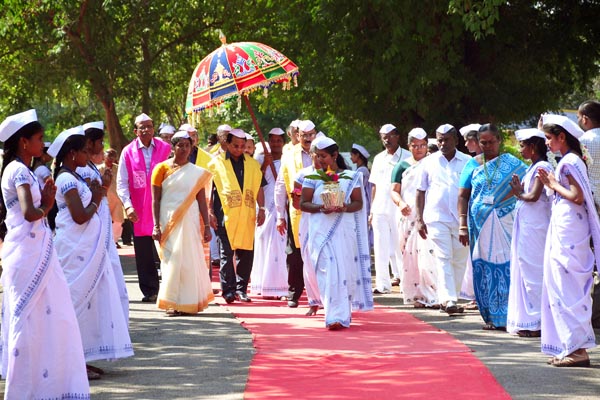
Shanthi Sena, (Peace Corps) in GRI was founded in 1958, 18 years before becoming a Deemed University. Since, GRI has always been a testing ground for many Gandhian experiments, the founding father of GRI, Dr G. Ramachandran took upon himself the task of establishing within this institution of higher education a nonkilling alternative to military training—a Shanti Sena. Even when GRI, upon becoming a Deemed University, was presented with the choice to adopt National Cadet Corps (NCC), it chose to continue with Shanthi Sena instead. By doing it, GRI became the only educational institution in the whole of globe to have adopted this model.
Combining spiritual, physical, intellectual, and organizational training, the Shanti Sena prepared students for conflict resolution, security functions, disaster relief, and cooperative community service in response to community needs. The approach is always to work together with villagers to improve such things as childcare, sanitation, housing, and preservation of folk arts traditions. The Shanti Sena in GRI until recently assumed responsibility for campus security. No armed police were permitted on GRI campus or if permitted they used to play second fiddle to Shanthi Sena, even during visits by Indian prime ministers Pundit Nehru, Mrs. Indira Gandhi, or Presidents Shri R. Ventkatraman, Shri Abdul Kalaam and other dignitaries. Besides providing security, when such dignitaries and prominent leaders visit the GRI campus, Shanthi Sena remains at the forefront in according them floral tributes and grand welcome.
The six-decade long experience of Shanthi Sena in GRI includes taking initiatives in peace building, promoting democracy and governance by conducting peace dialogues, inter-religious dialogues, youth exchange programmes, youth camps, leadership training programmes, sports for peace programmes and prohibition (abolition of arrack) in the neighbouring villages. They are actively involved in emergency relief, peace education, environmental conservation and providing community based health facilities in the rural areas nearby.
Every year, many students of the Institute volunteer to become part of Shanthi Sena and carry rich experiences and fond memories with them when passing out from GRI.
Yoga


The Gandhigram Rural Institute (GRI) celebrates International Yoga Day every year on June 21 to promote physical and mental well-being. The Institute offers yoga education to undergraduate students and organizes yoga competitions, demonstrations, and practice sessions to encourage student participation and promote healthy living, concentration, discipline, and holistic development.
- 21 JuneInternational Yoga Day, celebrated every year
- UndergraduateYoga education for students
- PracticeCompetitions, demonstrations and practice sessions
Gandhian Principles and Ideologies
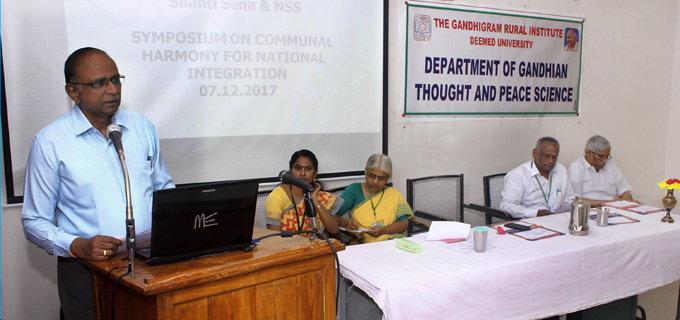
Students of this Institute study Gandhian life and experiments. Gandhian Ideologies, Gandhian Economics and Gandhian constructive programmes are incorporated in the curriculum. This enables them to develop tolerance and other ethical and moral values.
Village Placement Programme
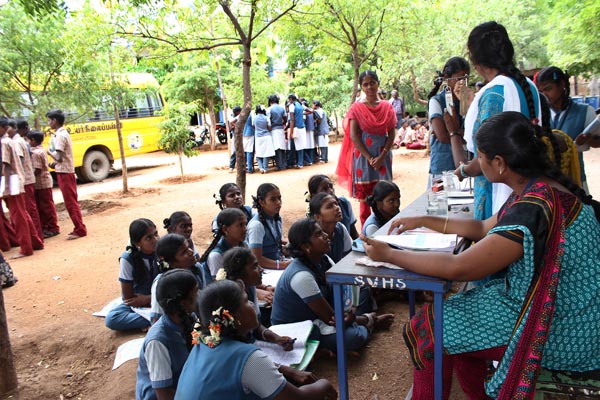
All the students of the Institute are placed in the neighboring villages for a period of seven days in each academic year. During their stay, the students understand rural environment, undertake household surveys, and prepare reports for development activities. They conduct medical and health care and literacy campaigns. The students undertake Shramdhan activities every day during their stay in the villages.
Promotion of Khadi
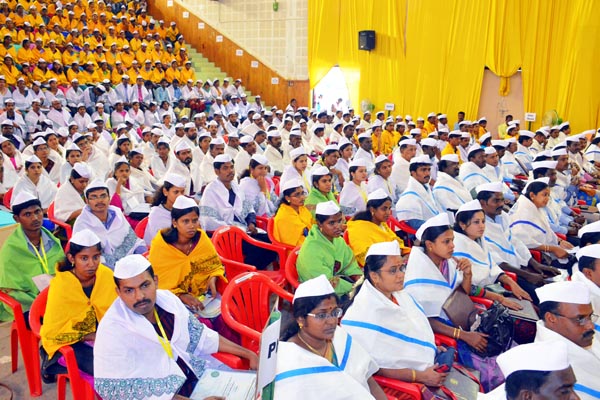
Students and staff wear khadi dress on Fridays in a week. Beside, Khadi shawls are used to honour guests in the university functions. Traditionally, the graduates and Chancellor, Vice-Chancellor and members of academic bodies wear khadi shawls and caps in the annual convocation event.